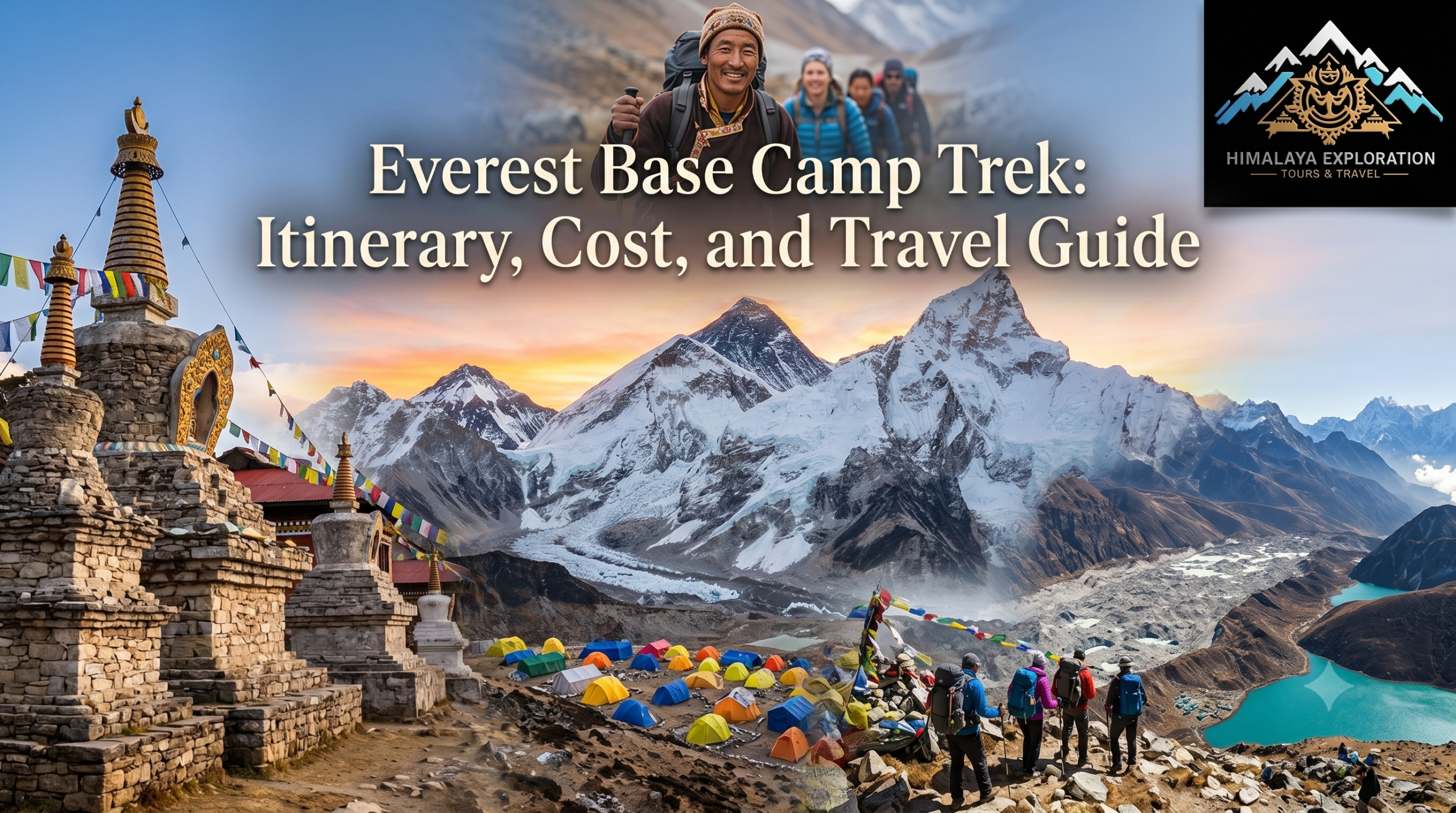
The Everest Base Camp Trek is widely considered the “Mother of all Treks.” Standing at the foot of the world’s highest peak, Mount Everest (8,848.86m), is a dream shared by thousands of adventurers across the globe. For many, this is not just a hike; it is a pilgrimage into the heart of the Khumbu region, a test of physical endurance, and an opportunity to witness the raw power of the Himalayas.
At Himalaya Exploration Tours & Travel, we have spent years perfecting the art of the high-altitude journey. Whether you are an Indian traveler seeking a spiritual connection with the mountains or an international trekker looking for the ultimate bucket-list challenge, our 2026 guide provides every detail you need to transform this dream into reality.
Understanding the Everest Base Camp Trek
The trek takes you through the Sagarmatha National Park, a UNESCO World Heritage site known for its unique Sherpa culture, ancient monasteries, and dramatic alpine landscapes. The trek continues to evolve with better infrastructure, improved teahouse facilities, and more streamlined permit processes, making it more accessible than ever.
The journey typically starts with a thrilling flight to Lukla, often called the world’s most adventurous airport. From there, you follow the Dudh Koshi River, crossing high suspension bridges and ascending through pine forests into the high-altitude deserts of the upper Khumbu.
Feel free to contact us on WhatsApp at +977 9851361516 or email us at inquiry@himalayaexploration.com.np if you require any clarification, customization, or modifications. Our team will be glad to assist you.
Detailed 14-Day Everest Base Camp Trek Itinerary
A successful trek requires a careful balance of movement and rest. Our standard 14-day itinerary is designed to maximize acclimatization and ensure you reach the base camp safely.
Day 1: Arrival in Kathmandu (1,400m)
Upon arrival at Tribhuvan International Airport, our team will greet you and transfer you to your hotel. We use this day for gear checks and a comprehensive pre-trip briefing.
Day 2: Fly to Lukla (2,860m) and Trek to Phakding (2,610m)
An early morning flight takes you to Lukla. The trek starts with a gentle descent toward the Dudh Koshi River. You will stay overnight in the charming village of Phakding.
Day 3: Trek to Namche Bazaar (3,440m)
The trail enters the Sagarmatha National Park at Monjo. After crossing the high Hillary Suspension Bridge, you face a steep ascent to Namche Bazaar, the vibrant “Sherpa Capital.”
Day 4: Acclimatization Day in Namche Bazaar
This is a critical rest day. We recommend a hike to the Everest View Hotel for your first clear look at Everest, Lhotse, and Ama Dablam.
Day 5: Trek to Tengboche (3,860m)
The trail winds around the mountainside before descending to the river and rising again through rhododendron forests to reach the famous Tengboche Monastery.
Day 6: Trek to Dingboche (4,410m)
As you pass the tree line, the landscape becomes more rugged. You will walk through Pangboche village and into the Imja Valley to reach Dingboche, a village protected by stone walls.
Day 7: Second Acclimatization Day in Dingboche
To help your body adjust to the thinning air, we hike to Nangkartsang Peak (5,083m). This offers incredible views of Makalu, the world’s fifth-highest peak.
Day 8: Trek to Lobuche (4,940m)
The trail climbs toward the Thukla Pass, where you will find memorials dedicated to climbers who lost their lives on Everest. From here, it’s a steady climb to Lobuche.
Day 9: Trek to Gorak Shep (5,164m) and Everest Base Camp (5,364m)
This is the big day. You will trek to Gorak Shep, have a quick lunch, and then continue to Everest Base Camp. After celebrating your achievement and taking photos at the Khumbu Icefall, you return to Gorak Shep for the night.
Day 10: Hike to Kala Patthar (5,545m) and descend to Pheriche (4,240m)
Before dawn, we hike to the summit of Kala Patthar for the most spectacular sunrise view of Everest. Afterward, we begin our long descent to Pheriche.
Day 11: Trek to Namche Bazaar (3,440m)
The return journey is much faster as you lose altitude. You will retrace your steps through Pangboche and Tengboche to reach the comforts of Namche.
Day 12: Trek to Lukla (2,860m)
The final day of walking. You will descend the steep hill from Namche and follow the river back to Lukla for a celebratory final dinner with your crew.
Day 13: Fly back to Kathmandu
A morning flight returns you to the capital. Use the afternoon for souvenir shopping or a well-deserved massage in Thamel.
Day 14: Final Departure
Our representative will drop you at the airport for your flight home, carrying memories of the Everest region that will last a lifetime.
Everest Base Camp Trek Cost Analysis for 2026
The cost of the trek varies based on your nationality and the level of service you require. Here is a breakdown of the Everest Base Camp Trek package price for 2026:
For Nepali Citizens
The total cost typically ranges from NPR 60,000 to 120,000+ per person. This depends on whether you opt for a budget teahouse experience or a more comfortable guided service.
For Indian Tourists
The Everest Base Camp Trek cost for Indians starts from INR 75,000+. This includes standard flights, permits, and teahouse accommodation. Indian trekkers often find this price highly competitive compared to other international destinations.
For International Tourists
For trekkers from other nations, the price starts from USD 1,400+. This covers the higher permit fees for non-SAARC citizens, international-standard guiding services, and all logistics.
Variables Affecting the Price:
- Group Size: Larger groups (10+) often receive significant discounts.
- Mode of Transportation: Flying directly from Kathmandu vs. driving to Ramechhap and then flying to Lukla.
- Hotel Category: Staying in luxury lodges (like Yeti Mountain Home) significantly increases the cost.
- Porters: Adding a private porter will add roughly $20–$25 per day to your budget.
Top 7 Attractions on the Everest Base Camp Route
1. Lukla Airport (Tenzing-Hillary Airport)
Landing here is an attraction in itself. At 2,846m, the short, uphill runway carved into a mountainside provides an adrenaline rush that kicks off your trip.
2. Namche Bazaar
The horseshoe-shaped town is the heart of Sherpa culture. It features cafes, gear shops, and even the world’s highest Irish Pub. It is the last place to find high-speed internet and ATMs before the high altitude.
3. Tengboche Monastery
Located at 3,860m, this is the largest gompa in the Khumbu region. The backdrop of Ama Dablam makes it one of the most photographed spots in the world. Visitors can often observe monks during their daily prayers.
4. Khumbu Glacier and Icefall
As you approach Gorak Shep, you walk alongside the massive Khumbu Glacier. From Base Camp, you can see the treacherous Khumbu Icefall, the first major obstacle for Everest climbers.
5. Kala Patthar
While Base Camp is the goal, Kala Patthar (5,545m) is where you get the best views. It is the highest point of the trek and offers a panoramic view of Everest, Nuptse, and Pumori.
6. Sagarmatha National Park Museum
Located just above Namche, this museum offers insights into the local flora, fauna, and the history of Everest expeditions.
7. Hillary Suspension Bridge
Draped in prayer flags and swaying high above the Dudh Koshi River, crossing this bridge is a rite of passage for every EBC trekker.
Feel free to contact us on WhatsApp at +977 9851361516 or email us at inquiry@himalayaexploration.com.np if you require any clarification, customization, or modifications. Our team will be glad to assist you.
Essential Travel Tips for EBC Trekking
Packing Suggestions
- Layers are Life: Bring moisture-wicking base layers, a warm fleece, and a heavy down jacket rated for -15°C.
- Footwear: Use broken-in, waterproof trekking boots. Do not try out new boots on the first day of the trek.
- Sleeping Bag: Even though teahouses provide blankets, a personal sleeping bag rated for -10°C is essential for hygiene and warmth.
Health and Safety
- Acclimatization: Never skip your rest days in Namche and Dingboche. Your body needs time to create more red blood cells.
- Hydration: Drink at least 4 liters of water daily. Use purification tablets or a filter—avoid buying plastic bottles to help preserve the environment.
- Medication: Carry Diamox for altitude, but consult your doctor first. Always have a basic first aid kit with blister tape and rehydration salts.
Currency and Connectivity
- Cash is King: While some places take cards, they charge a high fee. Carry enough NPR (Nepalese Rupees) for snacks, hot showers, and charging your electronics.
- Ncell/NTC: Local SIM cards work up to Dingboche. For higher elevations, you may need to purchase “Everest Link” Wi-Fi cards.
Why Choose Himalaya Exploration Tours & Travel?
We understand that you have many choices for your Nepal adventure. Here is why we stand out:
- Competitive Pricing: We offer direct-from-source pricing without middleman fees.
- Local Expertise: Our guides are born and raised in the mountains. They don’t just know the trail; they know the people and the stories.
- Safety Protocol: Every group carries an oximeter to monitor blood oxygen levels and a comprehensive medical kit.
- Customization: Want to return by helicopter from Base Camp? Or add a detour to Gokyo Lakes? We can tailor any itinerary to your needs.
- Trusted Service: Our 2026 reviews speak for themselves—we prioritize your experience and safety above all else.
Special Deals and Group Discounts
- Early Bird Offer: Book 6 months in advance for a 10% discount.
- Group Special: Groups of 5 or more get one person’s trek at 50% off.
- Seasonal Discount: Looking for a quieter trail? Book in early March or late November for special rates.
Book Now! The mountains are calling, and the 2026 season is filling up fast. Don’t wait to claim your spot on the world’s most famous trail.
Frequently Asked Questions (FAQs)
1. How difficult is the Everest Base Camp Trek?
It is a moderate to strenuous trek. You don’t need technical climbing skills, but you do need good cardiovascular fitness and the ability to walk 5-7 hours a day.
2. What is the best time for the Everest Base Camp Trek?
The best seasons are Spring (March to May) and Autumn (September to November). Spring offers blooming rhododendrons, while Autumn provides the clearest mountain views.
3. Can I do the EBC trek without a guide?
As of 2026, the Nepal government strongly recommends or mandates (depending on specific regional updates) a licensed guide for safety and environmental protection.
4. How do I get from Kathmandu to Lukla?
Most trekkers take a 35-minute domestic flight. During peak seasons, these flights often depart from Ramechhap (a 4-5 hour drive from Kathmandu) to avoid air traffic.
5. What kind of accommodation is available?
You will stay in “Teahouses,” which are mountain lodges. They offer basic twin-sharing rooms. In lower regions, you can find rooms with attached bathrooms.
6. Is the water safe to drink?
No. You must use water purification tablets, drops, or a UV filter. Buying bottled water is expensive and bad for the environment.
7. What is the maximum altitude of the trek?
The highest point is Kala Patthar at 5,545m (18,192 ft). Everest Base Camp itself is at 5,364m.
8. Is there electricity to charge my phone?
Yes, most teahouses have solar power. They usually charge a fee of $2–$5 to charge a phone or power bank.
9. What should I do if I get altitude sickness?
The first rule is to stop ascending. If symptoms (headache, nausea, dizziness) persist, you must descend immediately. Our guides are trained to handle these situations.
10. Do Indian citizens need a visa for Nepal?
No, Indian citizens do not need a visa, but they must carry a valid Passport or Voter ID card for identification.
11. Is travel insurance mandatory?
Yes. Your insurance must specifically cover high-altitude trekking up to 6,000m and emergency helicopter evacuation.
12. Can I get a hot shower on the trail?
Yes, for a fee ($3–$7). In the higher villages like Gorak Shep, showers are often bucket-style.
13. What food is available?
The most popular dish is “Dal Bhat” (rice and lentils). You can also find pasta, pancakes, eggs, and even pizza. We recommend sticking to vegetarian food to avoid stomach issues.
14. How much weight can a porter carry?
A porter usually carries 20–25kg, which is typically shared between two trekkers.
15. Are there ATMs on the trek?
The last reliable ATMs are in Namche Bazaar. We recommend carrying all the cash you need from Kathmandu.
16. What permits do I need for EBC?
You need the Khumbu Pasang Lhamu Rural Municipality Permit and the Sagarmatha National Park Entry Permit.
17. Can I customize my EBC itinerary?
Yes, we can add days for the Gokyo Ri detour or the Chola Pass for a more challenging experience.
18. How do I prevent blisters?
Wear high-quality wool socks and ensure your boots are well-fitted. Use “Compeed” or zinc tape at the first sign of a hot spot.
19. Is there mobile network on the trail?
Yes, Ncell and NTC work in many areas, but the signal becomes weak or non-existent above 4,000m.
20. How do I book my trek?
Simply reach out via WhatsApp at +977 9851361516 or email us at info@himalayaexploration.com.
Feel free to contact us on WhatsApp at +977 9851361516 or email us at inquiry@himalayaexploration.com.np if you require any clarification, customization, or modifications. Our team will be glad to assist you.
Conclusion
The Everest Base Camp Trek remains the pinnacle of adventure travel. It is a journey that challenges your body while enriching your spirit. Walking in the footsteps of legends like Hillary and Tenzing, you will discover that the true reward isn’t just reaching the base camp, but the resilience you find within yourself along the way.
From the bustling streets of Kathmandu to the serene silence of the high Himalayas, every moment of this trek is designed to leave you in awe. In 2026, the trail is ready, the Sherpa hospitality is as warm as ever, and the peaks are waiting. Choosing a trusted partner like Himalaya Exploration Tours & Travel ensures that your only job is to put one foot in front of the other and take in the view. We invite you to join us on this extraordinary expedition. Life is short, and the mountains are tall—don’t wait to start your Everest adventure.
Important Links & Resources
Official Resources:
- Official Nepal Tourism Board – Essential travel updates and destination info.
- Department of Immigration Nepal – Visa and permit regulations for 2026.
- Sagarmatha National Park – UNESCO – Details on the park’s heritage and ecology.
- Himalayan Rescue Association – Expert advice on mountain safety and altitude sickness.
Learn More :