
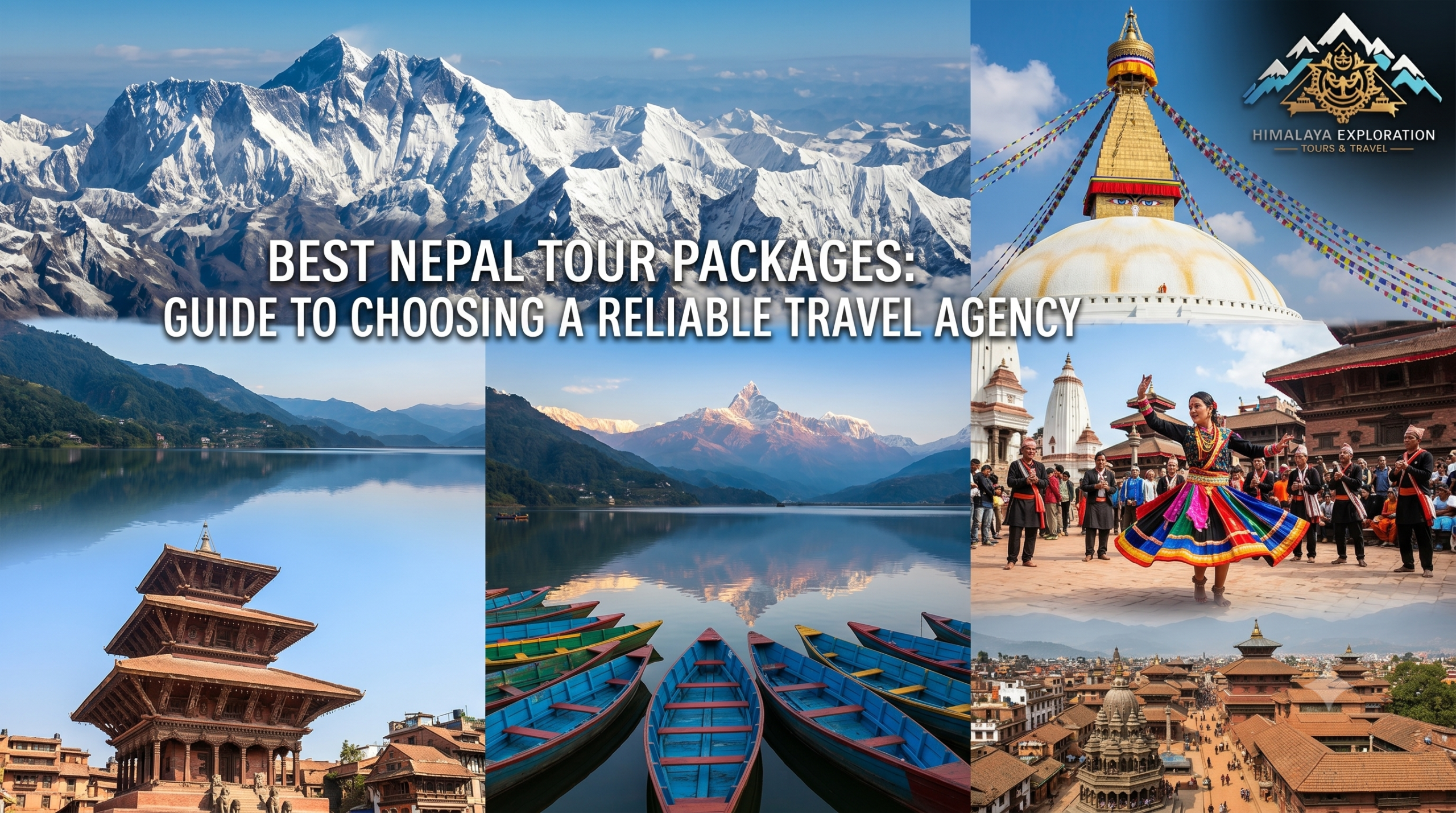
Nepal Tour Package is an exciting endeavor. Whether you want to witness the towering peaks of Mount Everest, walk through the ancient temples of Kathmandu, or track wildlife in the lush jungles of Chitwan, organizing the logistics can quickly become overwhelming. To guarantee a smooth and memorable experience, securing the best Nepal tour package through a trusted and verified travel agency is the most crucial step of your planning process.
Himalaya Exploration Tours & Travel is committed to offering clear, straightforward advice for travelers. A well-planned itinerary removes the stress of navigating unfamiliar transportation networks, deciphering local permit regulations, and finding high-quality accommodation. This guide provides actionable steps to evaluate travel operators and ensures you invest your money wisely for a safe and enriching journey.
Feel free to contact us on WhatsApp at +977 9851361516 or email us at inquiry@himalayaexploration.com.np if you require any clarification, customization, or modifications. Our team will be glad to assist you.
Why You Need a Reliable Travel Agency in Nepal
Traveling in a developing country with challenging geography presents unique hurdles. While the internet is full of DIY travel advice, relying on a professional local agency provides irreplaceable benefits.
First, transportation in Nepal can be unpredictable. Domestic flight schedules often shift due to mountain weather, and road conditions on major highways can change without notice. A reliable travel agency monitors these situations in real-time and restructures your itinerary instantly to prevent major delays.
Second, safety is paramount. When you travel to high altitudes or remote wildlife reserves, having a ground team that knows emergency protocols is non-negotiable. Legitimate agencies utilize trained, licensed guides who understand the symptoms of altitude sickness and know exactly how to handle medical emergencies.
Finally, travel operators give you access to authentic local experiences. Instead of reading plaques at tourist sites, a knowledgeable guide provides historical context, introduces you to local artisans, and helps you navigate cultural norms gracefully.
Key Factors to Consider When Choosing a Travel Agency
Selecting the best Nepal tour package means looking beyond the glossy photos on a website. You must vet the company running the tour. Here are the five primary factors you must check before making a deposit.
1. Verify Government Registration and Licenses
Never book a package with an unregistered company. In Nepal, legitimate travel and trekking agencies must be registered with several governing bodies. Ask the operator for proof of registration with the Department of Tourism and the Trekking Agencies Association of Nepal (TAAN). A government-licensed company is legally bound to follow safety and financial regulations, offering you a layer of protection in case of disputes.
2. Analyze Client Reviews and Testimonials
Independent reviews are the best indicator of an agency’s reliability. Do not solely rely on the testimonials posted directly on the company’s website. Check third-party platforms like TripAdvisor, Trustpilot, or Google Reviews. Look for patterns in the feedback. Consistent praise for specific guides, prompt communication from management, and effective handling of unexpected weather delays are strong indicators of a highly capable team.
3. Look for Transparent Pricing and No Hidden Costs
The best Nepal tour package will have a clearly defined list of inclusions and exclusions. Scrutinize the itinerary to see exactly what you are paying for. Does the package cover all three meals, or just breakfast? Are domestic flights included in the base price? Are museum and national park entry fees covered? A reliable agency will provide a transparent pricing structure so you do not encounter surprise expenses upon arrival.
4. Prioritize Customization and Flexibility
Every traveler has distinct physical capabilities and interests. Avoid operators that force you into a rigid, one-size-fits-all schedule. A professional agency will ask about your fitness level, dietary restrictions, and specific interests (such as photography, bird watching, or local cuisine) before finalizing your route. They should readily adjust the pace of the tour to ensure your comfort.
5. Assess Their Commitment to Safety and Responsible Tourism
Tourism heavily impacts the fragile Himalayan environment and the local communities. Ask the agency about their ethical practices. Do they hire local guides and porters from the regions you will visit? Do they adhere to proper weight limits for porters? Furthermore, ensure the company provides comprehensive safety gear when necessary and insists that all clients carry adequate travel and medical insurance.
Feel free to contact us on WhatsApp at +977 9851361516 or email us at inquiry@himalayaexploration.com.np if you require any clarification, customization, or modifications. Our team will be glad to assist you.
Benchmark Itinerary: The Best 7-Day Nepal Tour Package
To help you understand what a well-paced, professionally organized trip looks like, here is a breakdown of our most popular 7-day cultural and natural tour. This itinerary showcases the capital’s heritage, the dense jungles of the southern plains, and the spectacular mountain views of the central region.
Day 1: Arrival in Kathmandu
- Altitude: 1,400 meters (4,593 feet)
- Drive Distance: 6 km (Airport to Thamel/City Center)
- Duration: 30 minutesUpon landing at Tribhuvan International Airport, our representative will meet you and transfer you to your hotel. The remainder of the day is dedicated to resting and attending a brief orientation regarding the upcoming schedule. In the evening, you will enjoy a traditional welcome dinner.
Day 2: Kathmandu Valley Sightseeing
- Altitude: 1,400 meters (4,593 feet)
- Drive Distance: 15 km total across the city
- Walk Distance: 3 to 4 km across heritage sites
- Duration: 5 to 6 hours of guided explorationYou will spend the day visiting multiple UNESCO World Heritage sites. The tour includes the sacred Hindu temple of Pashupatinath, the massive Buddhist stupa of Boudhanath, and the historic architecture of Kathmandu Durbar Square. Your local guide will explain the intricate history and religious significance of each location.
Day 3: Drive to Chitwan National Park
- Altitude: 415 meters (1,361 feet)
- Drive Distance: 160 km
- Duration: 5 to 6 hoursLeaving the bustling valley behind, you will travel southwest via a scenic highway following the Trishuli River. The climate will gradually become warmer and more humid as you enter the Terai plains. After checking into your jungle lodge, you will take a brief walk through a local Tharu village to understand the indigenous culture of the region.
Day 4: Full Day Jungle Safari Activities
- Altitude: 415 meters (1,361 feet)
- Walk Distance: 4 to 5 km during nature walks
- Duration: 6 to 7 hours of varied activitiesYour day starts early with a serene canoe ride down the Rapti River, offering excellent bird watching and crocodile sightings. Following the river trip, you will take a guided jungle walk. In the afternoon, a jeep safari takes you deep into the park to track the endangered one-horned rhinoceros, Bengal tigers, and various species of deer.
Day 5: Drive to Pokhara
- Altitude: 822 meters (2,696 feet)
- Drive Distance: 140 km
- Duration: 4 to 5 hoursAfter breakfast, you leave the jungle and head north toward Pokhara, known as the “City of Lakes.” The drive offers changing landscapes, from flat agricultural lands to steep forested hills. Once you arrive and settle into your lakeside hotel, you have the evening free to stroll along the peaceful shores of Phewa Lake.
Day 6: Pokhara Exploration and Sarangkot Sunrise
- Altitude: 1,600 meters (Sarangkot viewpoint)
- Drive Distance: 25 km total
- Walk Distance: 2 km
- Duration: 5 to 6 hoursYou will wake up before dawn and drive up to the Sarangkot viewpoint to witness the sun illuminating the Annapurna and Dhaulagiri mountain ranges. After returning for breakfast, the day continues with visits to the International Mountain Museum, the underground Gupteshwor Cave, and the powerful Devi’s Fall. The afternoon concludes with a peaceful boating session on Phewa Lake.
Day 7: Fly back to Kathmandu & Departure
- Altitude: 1,400 meters (4,593 feet)
- Fly Distance: 145 km
- Drive Distance: 6 km (Hotel to Airport)
- Duration: 25 minutes flight, 30 minutes driveYou will take a short, highly scenic morning flight from Pokhara back to Kathmandu. Keep your camera ready, as the right side of the aircraft offers continuous views of the Himalayan chain. Depending on your international flight schedule, you may have time for last-minute souvenir shopping before the agency transfers you to the airport for your journey home.
Understanding Costs, Permits, and Travel Guidelines
A major component of choosing the best Nepal tour package is understanding the financial and legal requirements of your trip. Travel packages generally fall into three categories: budget, standard, and luxury.
- Budget Packages usually rely on tourist buses for city-to-city transport and standard guesthouses.
- Standard Packages offer private vehicle transfers, 3-star accommodations, and more comprehensive meal plans.
- Luxury Packages utilize 4-star and 5-star heritage hotels, domestic flights to bypass long drives, and highly personalized guiding services.
Regarding permits, independent navigation of the bureaucracy can take hours. A reliable agency handles all paperwork in advance. For standard cultural tours and jungle safaris, you will need National Park entry permits and municipal heritage site tickets. If you plan to add trekking to your package, the agency will secure your Trekkers’ Information Management System (TIMS) card and the specific Conservation Area permits (like ACAP for Annapurna or Sagarmatha National Park entry for Everest).
Feel free to contact us on WhatsApp at +977 9851361516 or email us at inquiry@himalayaexploration.com.np if you require any clarification, customization, or modifications. Our team will be glad to assist you.
FAQs About Nepal Tour Packages
We have compiled the most frequently asked questions from global travelers to help clarify your planning process.
1. What is the absolute best time to book a Nepal tour package?
The peak seasons are Spring (March to May) and Autumn (September to November). During these months, the weather is stable, the skies are generally clear for mountain viewing, and the temperatures are comfortable.
2. How many days do I need for a satisfying Nepal tour?
For a well-rounded experience covering Kathmandu, Chitwan, and Pokhara, a minimum of 7 to 10 days is recommended. If you wish to add a short trek, plan for 12 to 14 days.
3. Do I need a visa to enter Nepal?
Yes, most nationalities require a visa. Fortunately, Nepal offers a Visa-on-Arrival at Tribhuvan International Airport for many countries. You can also apply online in advance to speed up the process at the immigration desk.
4. How much does an average Nepal tour package cost?
A standard, comfortable tour package typically costs between $70 and $150 per person per day. This usually covers private transport, 3-star accommodation, guides, and entry fees.
5. Are Nepal tour packages safe for solo female travelers?
Yes, Nepal is widely considered one of the safest countries in South Asia for solo female travelers. Booking through a registered travel agency adds an extra layer of security and local support.
6. Is altitude sickness a concern on standard city tours?
No. Major tourist hubs like Kathmandu (1,400m), Pokhara (822m), and Chitwan (415m) are well below the altitude where Acute Mountain Sickness (AMS) typically occurs (usually above 2,500m).
7. Can I customize a pre-existing tour package?
Absolutely. Reliable travel agencies build flexibility into their operations. You can upgrade hotels, swap driving for flying, or add extra rest days based on your preferences.
8. What kind of clothing should I pack?
Pack in layers. Kathmandu and Pokhara can be warm during the day but chilly at night. Bring breathable cotton clothes for the day, a fleece or light down jacket for the evenings, and comfortable walking shoes.
9. Are meals included in the tour packages?
This varies by agency. Most standard tour packages include breakfast at the hotel. Lunches and dinners are often left open so you can explore local restaurants, except in places like Chitwan where all meals are typically included at the jungle lodge.
10. Can vegetarians or vegans easily find good food?
Yes, Nepal is highly accommodating to vegetarians and vegans. The national dish, Dal Bhat (lentil soup and rice with vegetable curries), is naturally vegan and available everywhere.
11. What is the transportation like between major cities?
You have three main options: domestic flights (fastest but more expensive), private hired cars (comfortable and flexible), or tourist buses (budget-friendly but slower).
12. Is travel insurance required for Nepal tours?
While it might not be legally mandated for basic city tours, all reputable agencies strongly advise purchasing comprehensive travel insurance that covers trip cancellations, medical emergencies, and delays.
13. How do I quickly verify if a travel agency is legitimate?
Ask for their company registration certificate, their license from the Department of Tourism, and their PAN/VAT registration numbers. Legitimate companies display these proudly on their websites.
14. What currencies are widely accepted in Nepal?
The local currency is the Nepalese Rupee (NPR). While major hotels and large agencies may accept US Dollars or Euros, you will need NPR for smaller restaurants, shops, and tips.
15. Are ATMs easily available?
ATMs are abundant in Kathmandu and Pokhara. However, if your tour takes you to rural areas or national parks, it is wise to carry sufficient cash as ATMs can be scarce or out of service.
16. How do local guides enhance the tour experience?
Local guides bridge the cultural gap. They handle ticket purchases, translate conversations, explain the deep historical context of temples, and recommend hygienic local eateries that you would not find on your own.
17. What permits are required for touring Nepal?
For city and jungle tours, you need heritage site entry tickets and National Park permits. If your package includes trekking, you will additionally need a TIMS card and specific regional conservation permits.
18. Can children or elderly people comfortably do a Nepal tour?
Yes, cultural and nature tours are highly suitable for all age groups. Agencies can tailor the pace, eliminate strenuous walks, and use private vehicles to ensure the comfort of children and seniors.
19. Do I need any specific vaccinations before visiting?
Consult your doctor before traveling. Generally, vaccines for Hepatitis A, Typhoid, and Tetanus are recommended. Malaria prophylaxis may be suggested if you spend extended time in the southern Terai plains during the monsoon.
20. What is the difference between trekking and touring in Nepal?
Touring relies primarily on vehicular transport or flights to visit cities, heritage sites, and wildlife parks with minimal strenuous physical activity. Trekking involves multi-day walking on mountain trails, sleeping in teahouses, and reaching high altitudes.
Important Links & Resources
Official Resources:
- Official Nepal Tourism Board – Essential travel updates and destination info.
- Department of Immigration Nepal – Visa and permit regulations for 2026.
- Sagarmatha National Park – UNESCO – Details on the park’s heritage and ecology.
- Himalayan Rescue Association – Expert advice on mountain safety and altitude sickness.
Learn More :

It’s great to hear about Nepal! I’ve always wanted to experience that blend of serenity and adventure – a good travel agency really makes all the difference.